
Assistant Professor, Harvard Medical School, Boston MA Director, Center for Molecular Therapeutics, Massachusetts General Hospital Cancer Center, Boston MA Associate Member, Broad Institute
BIOGRAPHY

MAR 23, 2021 9:00 AM PDT
Targeted degradation of the enhancer lysine acetyltransferases CBP and p300
Speakers
-

Tim Geiger, PhD
Field Applications Manager - Bio-TechneBIOGRAPHY

Date & Time
Date: March 23, 2021
Time: 9:00am (PST), 12:00pm (EST)
Abstract
The chromatin regulators CBP and p300 maintain gene expression programs through lysine acetylation of chromatin and transcriptional regulators and by scaffolding functions mediated by several protein-protein interaction domains. We have developed a chemical degrader of p300/CBP, dCBP-1, using in silico modeling and cellular activity assays including capillary-based immunodetection assays (ProteinSimple, WES). We have found that dCBP-1 is exceptionally potent at killing multiple myeloma cells and can abolish the enhancer that drive MYC oncogene expression. As an efficient degrader of this unique class of chromatin regulators, dCBP-1 will be a useful tool for understanding p300/CBP activity at enhancers in both normal and diseased cells.
Webinars will be available for unlimited on-demand viewing after live event.
You May Also Like
FEB 17, 2026 | 8:00 AM

In cell therapy applications, commonly employed cell purification platforms for large-scale isolation of immune or stem cells separate cells based on a single cell surface antigen. Enrichmen...
FEB 18, 2026 | 8:00 AM

With advancing food allergy research and emerging therapies, new allergy testing requirements arise. In this context, Basophil Activation Testing (BAT) has emerged as an essential component...
FEB 18, 2026 | 1:00 PM

Energy-efficient filtration solutions that reduce hidden chemical exposure from benchtop work and lab equipment to improve overall laboratory safety...
FEB 19, 2026 | 7:00 AM

Discover how Iconeus One, the premier functional ultrasound (fUS) system for neuroscientists, is transforming brain function studies. Based on ultrafast plane-wave sonography, Iconeus One of...
FEB 19, 2026 | 8:00 AM
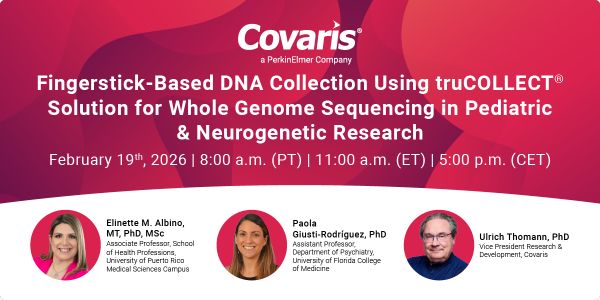
The collection of high-quality genomic DNA remains a major barrier in pediatric and neurodevelopmental research, particularly among children with autism spectrum disorder (ASD) and other neu...
FEB 23, 2026 | 9:00 AM
C.E. CREDITS

Explore decentralized liquid biopsy with SOPHiA GENETICS and MSK-ACCESS®, expanding access, improving outcomes, and accelerating precision oncology....
Loading Comments...